

The unfinished Theory of Constraints application: TOC for the Organization
3 June 2026
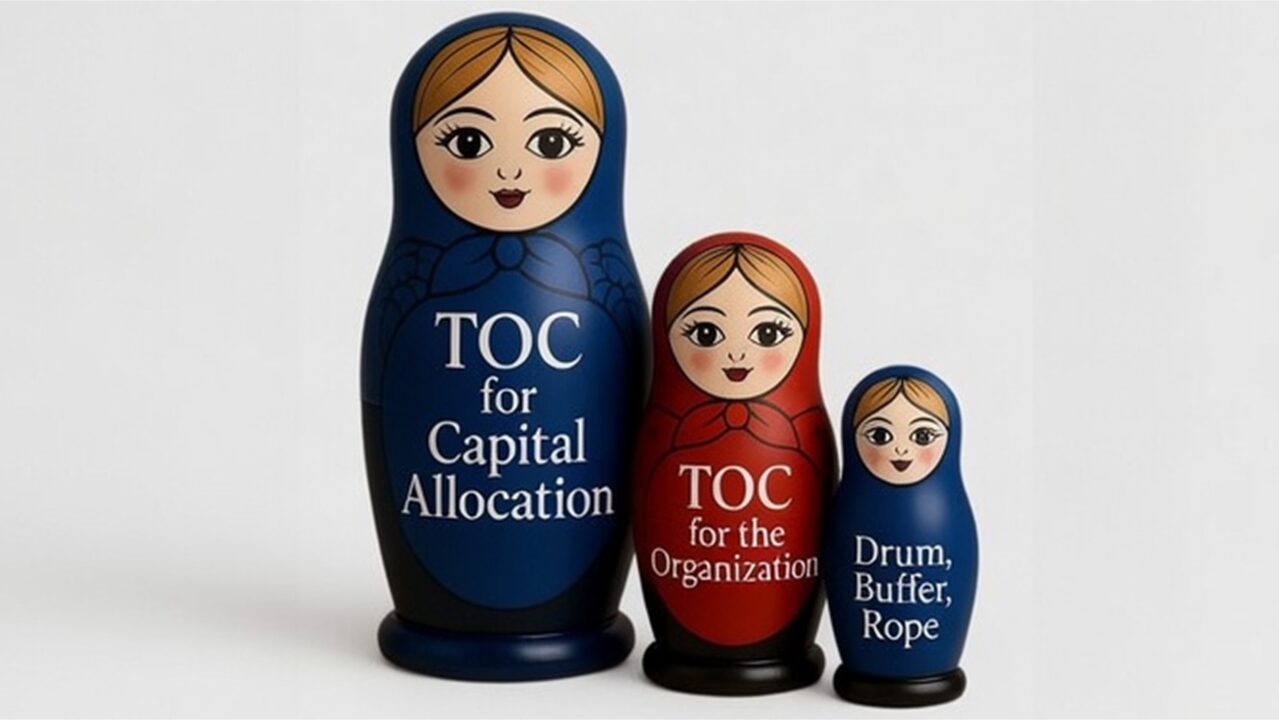
Like most of us, Eli Goldratt was in search of a grand unified theory. Not of physics (even though he was a physicist) but of business.
His Viable Vision project was an ambitious (though relatively unsuccessful) attempt to apply TOC to the entire organization, rather than to discrete operational areas such as production, projects, or distribution.
I’d like to humbly suggest that this pursuit was hampered by a bottom-up, rather than a top-down approach.
And, I’m starting to believe that the solution to the problem is hiding in plain sight: it becomes obvious once you change your perspective.
I’d like to present my proposed solution as a TOC “application” because it’s traditional in our community to think of TOC as a set of applications (DBR for production, CCPM for projects, etc).
Bottom-up versus top-down
Eli naturally took a bottom-up approach to organizational improvement because he started by solving a particularly acute problem in a specific part of the organization. Production.
He then realized that his core insight — the destructive impact of variability combined with dependency in complex systems — could be elevated into a broader set of principles. These principles could then be used to solve problems stemming from the same underlying cause in other parts of the organization, such as projects and distribution.
The idea behind Viable Vision was that if we were to approach an organization with a collection of TOC applications, we could profoundly improve its performance (and therefore its profitability).
My take is that Viable Vision’s results were underwhelming because it ran into a suboptimization problem. In other words, we discovered that you don’t maximize an organization’s performance by maximizing each of its parts. Of course, if I’m right, this is ironic given that we, in the TOC community, rail against suboptimization! This is fundamental to Eli’s original insight.
To avoid suboptimization problems (in any environment), it’s critical to start with a top-down approach. This is because local decisions must be made with a view to their global implications.
Eli knew this, of course. His famous book (The Goal) was named in recognition of this idea. A central lesson was that local decisions should be subordinated to the organization’s goal (to make money, now and in the future). But the story was told from the perspective of the manager of a production plant, who went looking for the constraint in HIS facility.
The story would have been less interesting if it were told from the perspective of the organization’s CEO, but if it were, here’s an interesting thought: maybe the CEO would have started by asking, “Where is the organization’s constraint?”
The top-down perspective
With that subtle shift in perspective, a profoundly different approach to organizational improvement comes into view.
Ask yourself, if the protagonist in Eli’s book were the CEO of UniCo, and not the manager of one of UniCo’s production plants, how would he have answered the question: Where is your organization’s Constraint?”
I don’t believe the CEO’s answer would have included any reference to the NCX-10 numerical control machine — even if that machine truly was limiting the organization’s overall performance.
This is because the CEO of any large organization does not view their organization as a collection of machines (or discrete resources). This is not just because of the cognitive load; it’s also because value is created by sets of resources (think, plants, departments, or groups).
It’s much more likely that the CEO would have answered the question by pointing to Alex Rogo’s plant.
The mistake that we’ve traditionally made in the TOC community is that we ask the question: “How do we improve the performance of the organization?” and then we attempt to answer the question from the perspective of a plant manager!
This doesn’t make a lot of sense. If the CEO is charged with maximizing the performance of the organization, we should be both asking and answering this question from the CEO’s vantage point.
TOC for the Organization
Accordingly, my position is that Eli’s unfinished application (TOC for the Organization) is simply the answer to the question, “How should the CEO act in order to maximize the performance of the entire organization?”
Here are the key implications of this top-down perspective.
First, while it was appropriate for Alex Rogo to view his plant as a collection of machines and operators, the organization’s CEO must adopt a scale-appropriate model of the entire organization. The CEO operates at a higher level of abstraction, where the mental model is populated with departments, functions, and business units, rather than machines and people.
Second, from the CEO’s perspective, the Constraint is not a resource you embark on a quest to find. It’s the primary value-generating resource around which your entire organization is structured. If you are the CEO of an airline, it should be pretty obvious to you that your organization’s Constraint MUST be your fleet of aircraft. Your organization is clearly at its most profitable when your fleet of aircraft is fully activated, and all other resources act to maximize this one critical resource.
Third, this high-level TOC application does not conflict with TOC applications at lower levels of the organization. Alex Rogo can and should maintain his own model of the plant. That model should still recognize a Goal and a Constraint — but in Alex’s case, the plant’s goal is not the organization’s goal. Instead, it is the parameter that Alex must maximize (or optimize) in order to effectively subordinate his plant to the organization’s goal.
Fourth, we must remember that the Constraint is not an inherent feature of reality itself — it is an attribute of our model of reality. To illustrate this, imagine creating three different models of your organization, each with different system boundaries. The first includes only resources under the direct control of the organization. The second expands to include customers and suppliers. The third encompasses the entire global economy. In each model, there will still be only one Constraint at any given time — but it will almost certainly be a different resource in each case. We, as the owners of the model, can choose where to draw the system boundaries, but it behooves us to do so to maximize the model’s utility.
The critical unlock (Russian dolls)
I believe it’s this fourth point that’s the critical unlock.
If you’re a plant manager, you can use the appropriate TOC application to improve the performance of your plant if (and only if) you understand how exactly your plant contributes to the performance of the organization as a whole.
But, you cannot possibly know this unless your CEO has first created a model of the overall organization and determined the organization’s Constraint. Improving your plant’s output might help the organization as a whole — or it might not. In some cases, you can better serve the organization by reducing production (for example, dropping back to a three-day week) so that working capital can be deployed more effectively elsewhere.
The TOC for the Organization application requires that we allow for systems within systems (Russian dolls).
We must accept that different stakeholders operate at different levels of abstraction and must therefore define “the system” differently.
For those who struggle to accept this idea, let’s return to Alex Rogo and bring a third party into our discussion. We have Alex, a plant manager. We have the CEO of UniCo (the parent organization). And now, let’s introduce the principal of the holding company that owns UniCo, as well as a number of other similar enterprises.
Each of these individuals will clearly have their own perspective on UniCo. Alex sees his plant. The UniCo CEO sees the organization as a whole. And the principal of the holding company has an entirely new perspective. They are charged with capital-allocation decisions across the portfolio of companies.
Obviously, each can build their own model. And obviously, each model will have different system boundaries, a different Goal, and a different Constraint.
This, whether we like it or not, is the nature of reality. And this is why a bottom-up approach to organizational improvement using TOC (or any other approach) will always result in suboptimization.
It’s time we recognized the requirement for a new TOC application. TOC for the Organization.